
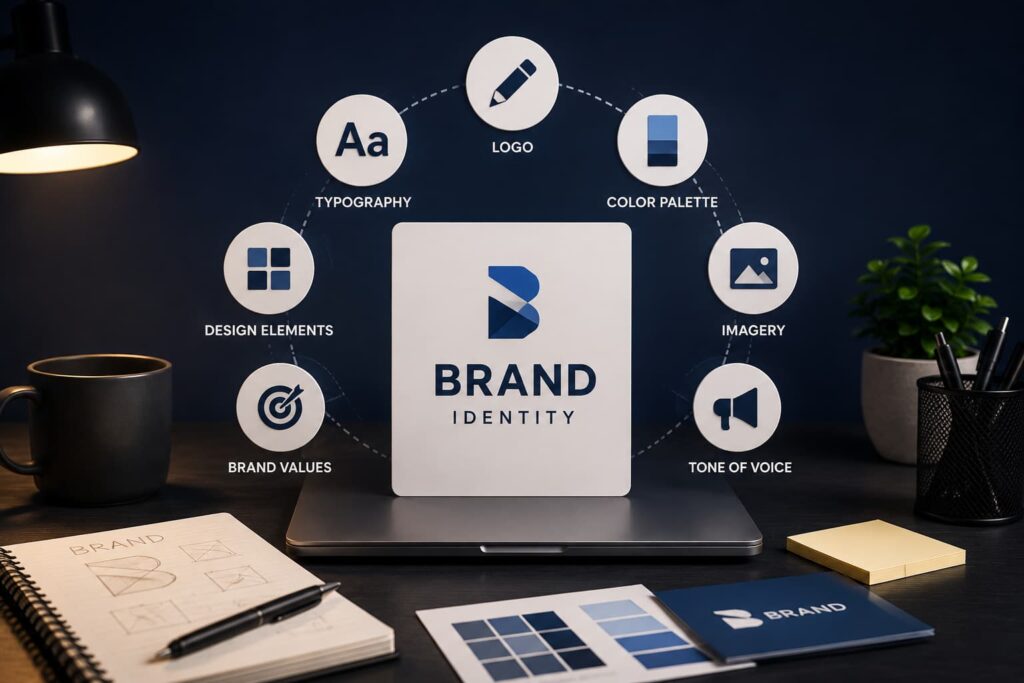

Imagine walking through a bustling market in Mumbai. Amidst the sea of colorful stalls, one shop catches your eye immediately. It’s not just the products; it’s the consistent look and the way the staff greets you that makes you stop. This feeling of recognition is what your business needs to thrive in the competitive Indian marketplace.

Building a cohesive Brand Identity is key to long-term success. It turns a simple company into a trusted name that resonates with your target audience. When you define your visual and emotional presence, you create a professional image that fosters lasting customer loyalty.
In today’s digital world, standing out is not just luck. You must master the seven essential elements that define how the world sees your work. By focusing on these pillars, your venture will stay memorable and impactful.
Key Takeaways
- A clear visual presence helps you stand out in crowded markets.
- Consistency builds trust and long-term loyalty with your customers.
- Professionalism is the foundation of a successful business image.
- Understanding your audience is vital for effective communication.
- Strategic planning turns a small shop into a recognized name.
Defining Your Brand Identity in the Indian Market
Creating your Brand Identity in India is a mix of old traditions and new ideas. India is a mix of many languages, customs, and ways of living. To win, you need to understand and respect these differences.
Building a good brand strategy means listening to what Indian people want. Whether it’s city folks in Mumbai or families in smaller towns, your message must be real and connect with them. By knowing what people in different places like, you can build strong relationships and loyalty.
Knowing the local market is key to staying ahead. When your Brand Identity shows you care about local events, values, and trends, you become a trusted friend. This smart move can make your brand stand out and grow.
A smart brand strategy is your guide to growing in India. By matching your look and words with what your audience expects, you keep your brand fresh. Taking the time to learn about local tastes will help you win over people in this changing market.
Step One: Establishing Your Core Brand Purpose and Values
Before you start designing a logo or choosing colors, you need to know what drives your business. A clear purpose is like a compass for your business branding. It makes sure every decision fits with your long-term goals. Without this, your efforts might not stand out in a busy market.
Identifying Your Unique Value Proposition
Your unique value proposition (UVP) is what you promise to your customers. It tells them why they should choose you over others. To find this, look at what makes your company branding special.
Ask yourself these key questions to focus your efforts:
- What problem does your product solve for Indian consumers?
- How does your service make their lives better?
- What sets your approach apart from others in India?
Answering these questions helps you create a clear story that builds brand value. This makes it easy for customers to know what you’re about from the start.
Aligning with Indian Consumer Sentiments
Success in India comes from connecting with the country’s emotional and social values. Here, trust, family, and community are key. Your company branding should show these values to build real loyalty.
When your mission matches local values, you’re more than just a vendor. You become a partner in your customers’ lives. This is how you grow your brand value over time.
To make your business branding resonate with locals, focus on these:
- Empathy: Show you get the unique challenges of the Indian market.
- Reliability: Build trust with consistent quality and clear communication.
- Cultural Relevance: Celebrate local traditions and festivals in your messages.
Step Two: Designing a Memorable Logo
In the competitive Indian market, your logo design must communicate your values at a single glance. It serves as the primary visual anchor for your business branding. This silent ambassador greets your customers before you even speak. A strong icon helps your company stand out in a landscape filled with diverse choices.
Principles of Effective Logo Design
To create a lasting impression, your logo must adhere to the core tenets of simplicity and clarity. A cluttered design often fails to resonate because it confuses the viewer. Instead, focus on clean lines and shapes that remain recognizable even when scaled down for a business card or a mobile app icon.
Versatility is another critical factor in professional logo design. Your symbol should look equally impressive on a large billboard as it does on a small social media profile picture. By keeping the design uncluttered, you ensure that your brand remains consistent across every digital and physical touchpoint.
Cultural Considerations for Indian Branding
When you operate in India, your visual symbols must respect local sensibilities and traditions. Colors, shapes, and icons often carry deep cultural meanings that can influence how your audience perceives your business branding. For instance, certain colors may evoke feelings of prosperity or purity, while specific motifs might hold religious or regional significance.
Always conduct thorough research to ensure your imagery is inclusive and avoids unintended negative connotations. A thoughtful approach to your logo design demonstrates that you value your customers’ heritage. By aligning your visual identity with the cultural fabric of the region, you build a deeper, more authentic connection with your target audience.
Step Three: Selecting a Strategic Color Palette
A strategic color palette is key to how your brand is seen in India. Your colors act as a silent ambassador, sharing your values before words are read. By picking the right hues, you make a visual identity that people remember.

Psychology of Colors in Marketing
Colors can make people feel certain ways, which can affect their buying choices. Knowing the psychology of colors helps guide customers. Warm colors can make people feel urgent or excited, while cool colors build trust.
Your brand’s personality should guide your color choices. For example, deep blues or blacks show innovation and authority. Bright colors like orange or yellow make your brand seem friendly and lively.
Choosing Colors That Resonate Locally
In India, colors have deep cultural meanings that go beyond global trends. You need to think about how colors are seen locally to make your brand authentic and respectful. What one color means in one place might mean something else elsewhere, so local research is key.
For instance, gold is linked to wealth and good luck, making it great for high-end brands. Bright greens symbolize growth and freshness, fitting well with agriculture and wellness. Using colors that match these cultural values helps you connect more with your audience.
| Color | Common Association in India | Best Used For |
|---|---|---|
| Saffron | Spirituality and Courage | Heritage and Premium Brands |
| Gold | Wealth and Prosperity | Luxury and Festive Campaigns |
| Green | Growth and Freshness | Organic and Wellness Products |
| Blue | Trust and Stability | Banking and Technology |
Step Four: Choosing Consistent Typography
Typography is the silent voice of your brand. It speaks before words are read. It’s like a visual handshake that shows how customers see your business in India.
Choosing the right typeface makes your brand’s identity strong. It connects with your audience in a meaningful way.
Selecting Fonts That Reflect Brand Personality
Your font should show your company’s values. For a modern and innovative look, clean sans-serif fonts are best. They show efficiency and forward thinking, great for tech startups.
If your brand is traditional or heritage-based, serif fonts are better. They bring trust and longevity. Many Indian brands mix these styles for a global appeal. Keep your typography consistent everywhere to be recognized.
“Typography is the voice of the design. It is the way you speak to your audience without saying a word.”
— Anonymous
Ensuring Readability Across Digital and Print
A beautiful font is useless if it’s hard to read. Prioritize readability for digital and print. Test fonts at different sizes to keep them clear.
Digital needs fonts that look good on screens and small devices. Print needs high contrast and spacing to avoid blurring. Use a strict hierarchy of font sizes and weights for clear messages.
Step Five: Developing a Distinct Brand Voice
In the diverse Indian market, your brand voice connects your values to what your customers want. It’s the personality your business shows in every interaction. From social media to customer emails, a unique voice turns marketing into a meaningful conversation that wins loyalty.
Defining Your Tone and Style
To find your voice, think about what your company stands for. Decide if you want to sound serious and professional or friendly and open. Being consistent helps your audience know it’s you, no matter where they see you.
After picking your tone, write it down in a style guide. This keeps your team on the same page. Your guide should cover what words and feelings you use. Keeping a steady personality makes your customers feel at ease with your brand.
Adapting Language for Diverse Indian Audiences
India’s many languages and cultures need a careful touch in communication. Your messages should be inclusive, respecting local feelings and traditions. A one-size-fits-all approach usually misses the mark for different states and communities.
Try adding local touches or cultural references to your brand. This makes your brand relatable and authentic. When you speak your audience’s language, you build trust. It shows you care about them, not just their money.
Make sure your messages are clear and easy to find on all digital platforms. By mixing global standards with local touches, your brand voice will shine in India’s crowded market.
Step Six: Curating Authentic Brand Imagery
Authentic imagery connects your brand with your customers. In India’s competitive market, your visual choices are key to company branding success. By avoiding generic stock photos, you create a unique space that speaks to your audience.
The Role of Photography and Graphics
Photography and graphics are your business’s main language. Using genuine photos of your team, office, or products offers a peek into your operations. This makes your company branding stronger by showing the people behind your services.
Steer clear of common, polished stock images that lack authenticity. Opt for custom photography that reflects your local business environment. Also, ensure your graphics match your color scheme for a unified look across all platforms.
Building Trust Through Visual Storytelling
Visual storytelling humanizes your business and builds lasting loyalty. When customers see real images of your work, they trust their buying decisions more. This transparency is crucial in today’s digital world.
“A brand is no longer what we tell the consumer it is—it is what consumers tell each other it is.”
— Scott Cook
By sharing your story through meaningful visuals, you invite your audience to join your journey. Consistent, honest imagery strengthens your company branding and differentiates you from competitors. Every image is a chance to deepen your connection with your community.
Step Seven: Mastering Brand Positioning
To succeed in the crowded Indian marketplace, you need a sharp and calculated approach to brand positioning. This process involves defining exactly where your business sits in the minds of your customers compared to your rivals. A solid brand strategy ensures that your unique value is not just visible, but also highly relevant to the local consumer.
Analyzing Competitors in the Indian Landscape
You must begin by mapping out the competitive terrain. In India, this means looking at both global giants and agile local startups that might be vying for the same attention. By conducting a thorough SWOT analysis, you can identify where your competitors are failing to meet customer needs.
“The essence of strategy is choosing what not to do.”
— Michael Porter
Consider the following factors when evaluating your competition:
- Pricing models: Are they premium, budget, or value-for-money?
- Service reach: Do they cover Tier-1 cities or have a strong rural presence?
- Customer feedback: What are users saying on social media about their pain points?
Finding Your Niche in the Market
Once you understand the gaps, you can carve out a specific space for your brand. Finding your niche is about focusing on a segment that is currently underserved or ignored by larger players. This targeted brand strategy allows you to build deeper loyalty with a specific group of people.
Use the table below to compare your potential positioning against common market archetypes:
| Archetype | Focus Area | Competitive Advantage |
|---|---|---|
| The Innovator | New Technology | First-mover status |
| The Value Provider | Affordability | High volume sales |
| The Specialist | Niche Quality | Expertise and trust |
Effective brand positioning is not a one-time task but a continuous commitment to your chosen identity. By staying true to your niche, you create a distinct advantage that is difficult for others to replicate. Keep refining your approach as the Indian market evolves to maintain your lead.
Maintaining Brand Consistency Across All Channels
In today’s fast-paced digital world, keeping a strong brand image is harder but more important than ever. If your message, visuals, and tone change too much between platforms, you might confuse your audience. This can weaken your market position. To achieve true brand consistency, every interaction with customers must reflect your core values.
Creating Comprehensive Brand Guidelines
To keep your team on the same page, you need a detailed set of brand guidelines. This document is like a blueprint for your business identity. It should cover your logo, colors, fonts, and the tone you use in different communications.
By giving your team and partners these clear rules, you avoid confusion. This consistency builds long-term recognition. It makes your brand seem reliable and professional to Indian consumers. Whether it’s a social media campaign or a physical store, these guidelines guide you.
“Consistency is the true foundation of trust. When a brand shows up the same way every time, it signals to the customer that they are dealing with a partner who values quality and integrity.”
Managing Brand Image in a Digital-First World
In today’s digital world, managing your brand image requires quick action and constant checks. News spreads fast on social media, and one off-message post can harm your reputation. You must keep your online and offline efforts in sync to offer a smooth experience.
The table below shows how to keep standards high across different media types. This ensures your brand consistency stays strong:
| Channel Type | Primary Focus | Consistency Goal |
|---|---|---|
| Social Media | Engagement & Tone | Unified Voice |
| Physical Store | Visual Identity | Brand Recognition |
| Email Marketing | Professionalism | Visual Alignment |
| Website | User Experience | Brand Authority |
Your commitment to these standards will show how well you grab your audience’s attention. By staying true to your guidelines, you protect your brand image from getting mixed up. This focus keeps your business a recognizable and trusted name in the market.
Measuring the Impact of Your Brand Identity
You can’t improve what you don’t measure, especially with your Brand Identity. Getting a foothold in the Indian market is a big deal. But knowing how your audience reacts to it is key for lasting success. By tracking certain metrics, you can see how your brand image affects people’s actions.
Tracking Brand Awareness and Recognition
To see how you’re doing in the market, watch how many people know your name and what they think of it. Brand awareness is tracked through website visits, social media, and searches for your brand. These signs show if your message is reaching the right people.
Brand recognition is about how well people can spot your visual stuff, like your logo. Surveys and groups can tell if your visuals match your values. Keeping an eye on this ensures your brand image stands out in a busy market.
“What gets measured gets managed.”
— Peter Drucker
Here’s a table with important metrics for a strong brand:
| Metric | Purpose | Frequency |
|---|---|---|
| Social Mentions | Track brand awareness | Weekly |
| Logo Recall | Measure brand recognition | Quarterly |
| Sentiment Analysis | Evaluate brand image | Monthly |
Adjusting Strategy Based on Performance Data
Data is only useful if you use it to make your Brand Identity better. If your metrics show a drop in interest, find out why. Maybe your message doesn’t match what people want to hear, or your look is old compared to others.
Use these insights to change your strategy wisely. Whether it’s tweaking your tone or updating your look, data-driven decisions help you avoid mistakes. Always improving is what keeps your Brand Identity strong and relevant in India’s changing scene.
Conclusion
Building a strong brand is about vision, knowing your culture, and hard work. You now have the key to succeed in the Indian market.
Keeping your brand consistent is key. Look at Tata and Amul, they show how important being true to your values is. By staying focused on your purpose and meeting your audience’s needs, you can build lasting loyalty.
Good planning makes your brand known. Use these seven tips to improve your look and sound. Your dedication to these ideas will help you create a lasting brand.
Begin using these tips in your business now. Keep an eye on how you’re doing, listen to what your customers say, and change as needed. Your path to a stronger brand starts with these steps.
For more details, feel free to visit our LinkedIn page
FAQ
Why is a cohesive brand identity crucial for your business in the Indian marketplace?
A cohesive brand identity is key for success. It helps you stand out in India’s competitive market. It builds trust and loyalty with customers.Brands like Tata Group show how a strong identity can work across different sectors and generations.
How can you tailor your brand strategy to fit the unique cultural landscape of India?
To tailor your brand strategy, understand India’s regional differences and language diversity. Align your messages with local sentiments to stay relevant. McDonald’s India did this well by adapting its menu and marketing.
What is the best way to identify your Unique Value Proposition (UVP) for your company branding?
To find your UVP, analyze what makes your products or services unique. Focus on the emotional or social benefits you offer. This makes your brand stand out, like Zomato did with its community-driven approach.
What principles should you follow for an effective logo design?
An effective logo should be simple and work well in all formats. It’s important to consider cultural symbols in India. A memorable logo, like the Amul girl, can greatly enhance brand recognition.
How do color choices impact your marketing and brand image?
Colors can influence how people feel and behave. Choose colors that resonate with your local audience. Brands like Airtel and Maggi use red and yellow to convey energy and celebration.
Why is consistent typography essential for maintaining brand consistency?
Typography reflects your brand’s personality and ensures messages are clear everywhere. Whether it’s modern or traditional, consistent typography makes your brand look professional and unified. This ensures a consistent experience for customers, whether online or offline.
How do you develop a distinct brand voice for a diverse Indian audience?
To develop a distinct voice, define a consistent tone and style that reflects your values. Adapt your language to be inclusive and relatable. Cadbury Dairy Milk, for example, has a joyful voice that connects with people across India.
How does authentic imagery help in building brand value and trust?
Using authentic imagery humanizes your brand and builds trust. High-quality visual storytelling, as seen in Fabindia’s campaigns, showcases real-life applications and cultural connections. This enhances your brand image and makes it more immersive and trustworthy.
How can you effectively master brand positioning against local competitors?
Brand positioning involves analyzing the competitive landscape to find your unique niche. Identify market gaps to capture your target audience’s attention. Reliance Jio, for example, positioned itself as the most accessible digital lifestyle provider, gaining massive awareness and market share.
What role do brand guidelines play in managing your brand image?
Brand guidelines are a blueprint for all marketing efforts, ensuring your brand image stays consistent. Following these guidelines is crucial in today’s digital world. It prevents message dilution and ensures your brand is instantly recognizable.
How do you measure the success of your brand recognition and awareness?
Success can be measured by tracking key performance indicators like brand awareness and recognition. Use digital analytics and consumer surveys to monitor how people perceive your brand. This allows you to adjust your strategy based on real data, keeping your brand competitive and relevant.